The 60-Second Encounter: Patient Experience Communication for Behavioral Health Teams
$39.00
ENTER, the patient communication method for behavioral health teams: mental health and psych techs, one-to-one observers, security, and everyone who works on the unit. Built around the CMS PIX survey, which names Counselors/Technicians by title. Calm words, checks with dignity, early signs, confidentiality. About 2 hours, with a certificate.
Description
Communicating With Psychiatric Patients on the Unit
This edition of The 60-Second Encounter teaches communicating with psychiatric patients for every role on a behavioral health unit: mental health and psych techs, one-to-one observers, security, and everyone else who works on the unit. It is written in plain words and built around how patients on an inpatient psychiatric unit are now asked to rate their care.
Who it is for. Behavioral health technicians, observers, unit security and other staff who spend the most time with patients, plus the charge nurses, supervisors and managers who lead them.
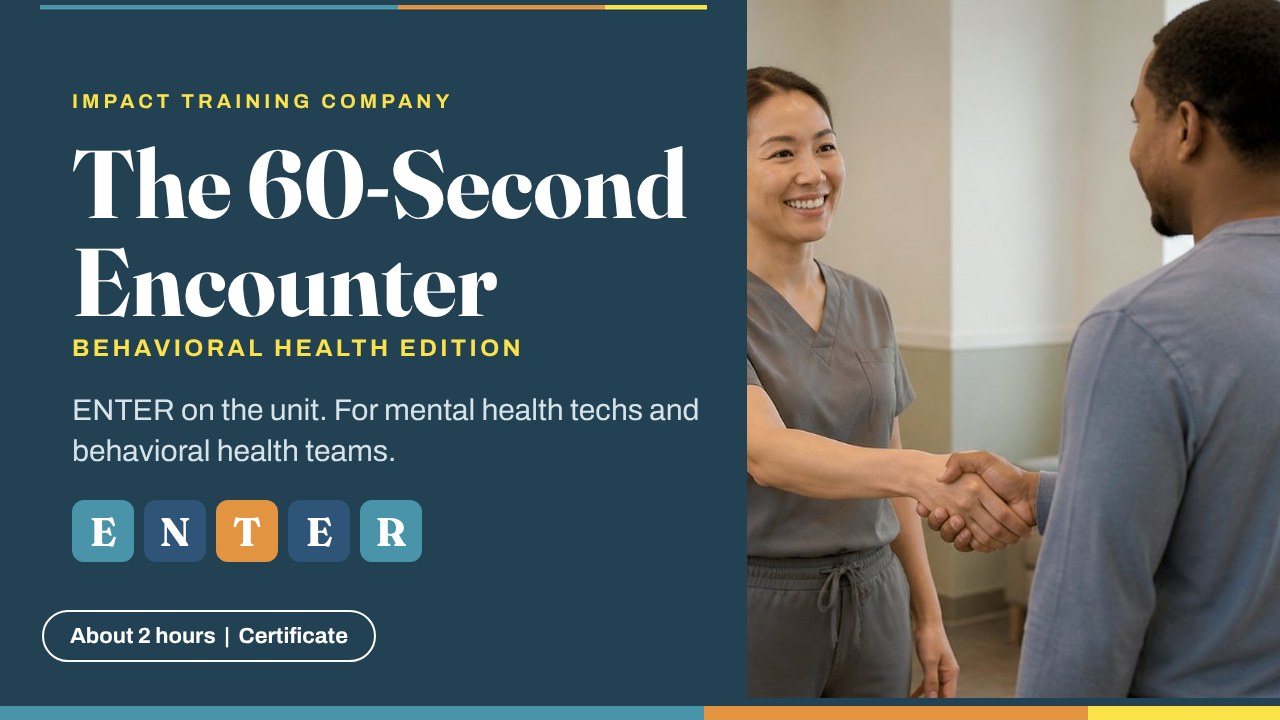
What you will be able to do. You will use ENTER on every encounter: enter and greet, name yourself, tell what happens, estimate the time, recap and thank. You will practice calm, person-first words, checks done with dignity, spotting early signs, and protecting confidentiality. The course explains the CMS Psychiatric Inpatient Experience (PIX) survey, which inpatient psychiatric facilities report starting January 1, 2026, and the statements that name Counselors/Technicians directly, so staff see why their part matters.
How it is built. The course has 10 lessons plus a practice lesson with 8 scenarios, a section for every behavioral health role, 3 short animations, a 20-question assessment and a certificate. You also get an ENTER Pocket Card, a Supervisor Huddle Guide and an Encounter Observation Sheet. Staff finish in about two hours.
The course does not teach physical intervention, which stays with your crisis training. It is professional development with no CE credit, and no specific score change is promised. Communicating with psychiatric patients well is a daily skill, and this gives your team a shared way to do it. See more courses on the behavioral health technician training page.
Reviews
There are no reviews yet.