Patient flow training from the book When Beds Don’t Move
Open beds. Full hospital. Here’s why.
When Beds Don’t Move: The Course is six short, self-paced patient flow training modules your leaders can put to work the next morning, released one at a time. Flow Physics 101 is open now.
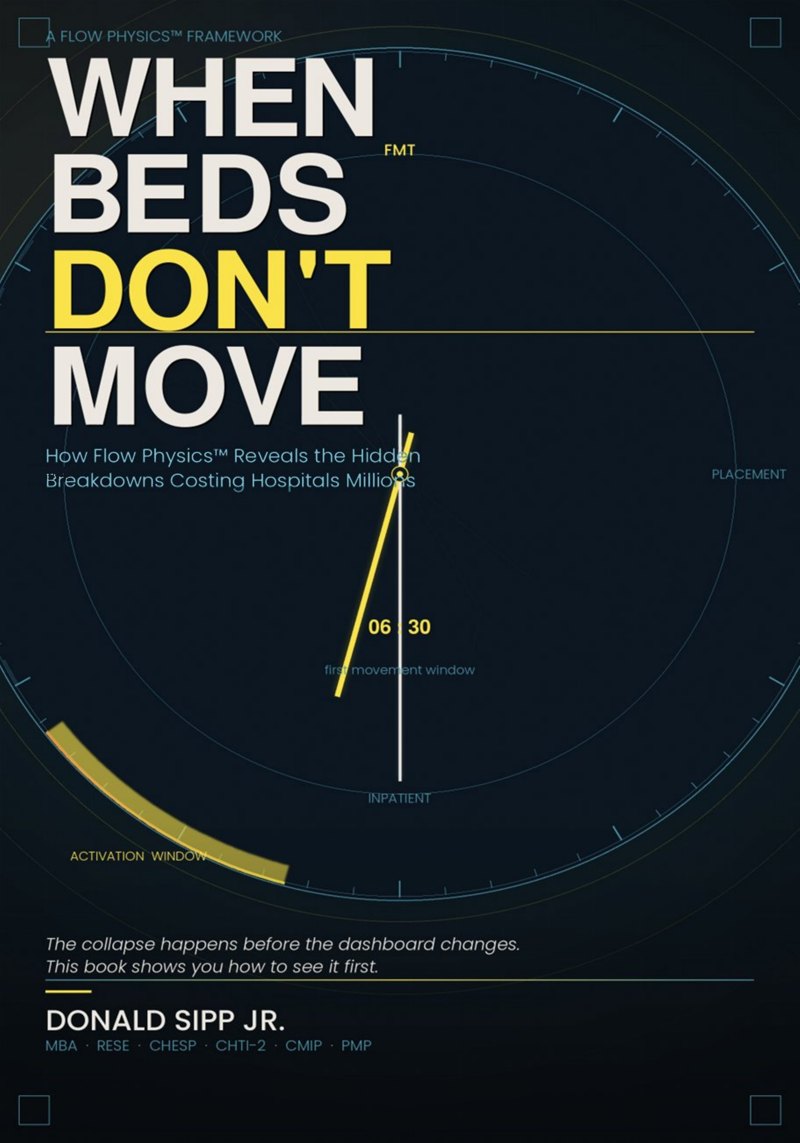
Best Seller
Aug 2026
“This book takes the complexity of hospital operations and turns it into practical, manageable principles that can actually be used to save facilities time and revenue.”
“A thoughtfully written instructional guide that gives you practical strategies you can easily put into action… I didn’t realize linens played such a major role in hospital productivity!”
Read the reviews on Amazon
Busy is not the same as moving
Most hospital throughput and ED boarding problems are blamed on staffing, volume, or bed capacity. The book shows they usually start earlier and upstream, in places no dashboard watches.
- The first hour sets the day.A five-minute slip before 7:00 a.m. turns into ED holds by mid-morning.
- Pressure shows up downstream.The unit that feels it is rarely the unit that caused it.
- Yellow is the last cheap fix.By the time signals turn Red, the outcome is already set.
Flow Physics™ gives leaders a shared language for this: First Movement Time, the Stagnation Gap, Activation Windows, and the five laws that explain why beds stop moving. What is Flow Physics™?
The Stagnation Gap™
Effort keeps rising while movement waits.
Six modules, in book order
Each module follows the book chapter by chapter, with its figures rebuilt and animated, a practice lab, and a tool you use on your own unit.
How the Invisible System Creates the Visible Day
Why open beds still feel full, First Movement Time, the Stagnation Gap, and the five laws.
The Engine Before the Engines, and the Hidden Discipline
Linen as the Readiness Engine, the Linen Flow Cycle, and acting at Yellow before the day turns Red.
The Support Services Chain
How EVS, Transport, and Placement hand the day to each other, and where those handoffs break.
The Clinical Engines
The ED, PACU, and inpatient units as engines that depend on everything upstream.
Holding the System
Seeing the hospital as one system and the leadership habits that keep it moving.
Drift Prevention and Flow as a Posture
Catching drift early and making flow the way your teams work every day.
See it before you buy
Lesson 1 of Flow Physics 101, “The 8:30 Call That Started at 6:47,” is free. Read it on your phone in about eight minutes.
After Flow Physics 101 you will be able to:
- Explain why open beds can still feel full
- Measure First Movement Time and the Stagnation Gap on your own unit
- Use the five laws of Flow Physics to find where your morning breaks first
What every module includes
Short, phone-friendly lessons built for leaders who have a shift to run.
Who this patient flow training is for
- EVS, Patient Transport, Linen, and Placement leaders and supervisors
- Bed management and patient flow teams
- Nursing operations and house supervisors
- Directors and executives responsible for throughput
- CHTI and CPTMP credential holders earning renewal CE
- Anyone who has read the book and wants to put it to work
Pricing
Start with one module. Move to the full course or a department pack as more modules launch.
Single module
1.5 or 2.0 CE hours each
- One module, self-paced
- Tool, practice lab, and knowledge check
- Certificate and CE credit
Full course
All six modules · 10.5 CE hours
- Saves $75 over buying each module
- Every tool and practice lab
- Available once all six modules are live
Department packs
Up to 10 learners · $3,390 for up to 25
- Full course for every learner
- Seats never expire and can be reassigned
- Completion and score report on request
Extra seats on either pack are $129 each. More than 25 learners? Contact us for a quote.
Amazon #1 Best Seller, Aug 2026Hospital Administration & CareAbout the author
Donald Sipp Jr., MBA, CHESP, RESE, PMP, CHTI-2, CMIP, Lean Six Sigma Black Belt, consults with hospitals and healthcare organizations across the country on Environmental Services, Patient Transport, Linen, and the support services that keep patients moving. He founded Impact Training Company, the home of the CHT, CHTI, and CPTMP credentials, and teaches as an Adjunct Professor.
When Beds Don’t Move is the first book in his Flow Physics™ Library. You do not need the book to take the course, but the two work well together.
Questions
How is this different from other patient flow training?
Most patient flow training starts at the bed board and discharge times. This course starts upstream, with the linen, EVS, and transport work that decides whether a bed can move at all, so leaders can spot hospital throughput problems before they reach the ED and turn into ED boarding.
Will this help with ED boarding and bed management?
Yes. ED boarding and bed management problems usually start hours earlier, when a room is cleaned late, a transport request stacks up, or beds are released in a bunch. The course shows your bed management and patient flow teams where the morning slips, so they can fix it before beds back up into the ED.
Does this count for CE?
Yes. Each module earns CE hours through Impact Training Company, recorded when you pass the knowledge check, and counts toward CHTI and CPTMP renewal.
Can I try it first?
Yes. Lesson 1 of Flow Physics 101 is free to read, no account needed.
Do I need the book?
No. Every module teaches its chapters on its own. The book adds depth if you want it.
How long does a module take?
About 1.5 to 2 hours, at your own pace. Lessons are short and work on a phone, so you can finish one between huddles.
Can I buy this for my team?
Yes. Department packs cover up to 10 or up to 25 learners, and seats can be reassigned when people change roles. Contact us to set one up.
How long do I have access?
Lifetime access to the edition you buy.
When do the other modules launch?
Flow Physics 102 is next, followed by 103 through 106. Sign up below and we will email you as each one opens.
Start today, hear about the rest
Flow Physics 101 is open now. Leave your name and email below and we will let you know when each new module launches.
We only email you about new Flow Physics modules. Unsubscribe anytime. Privacy policy