
Certificate Locked

Complete the course to unlock the certificate
0% Completed
Required 100%
A room can be clean, inspected and posted on the bed board, and still not be usable, because the bed has no fitted sheet. When Linen Stops Flow calls linen Engine 0: the layer that has to work before EVS can turn a room, transport can move a patient, or placement can assign a bed. When linen fails, every one of those steps inherits the delay, and the delay is almost always recorded as something other than linen. [Book]

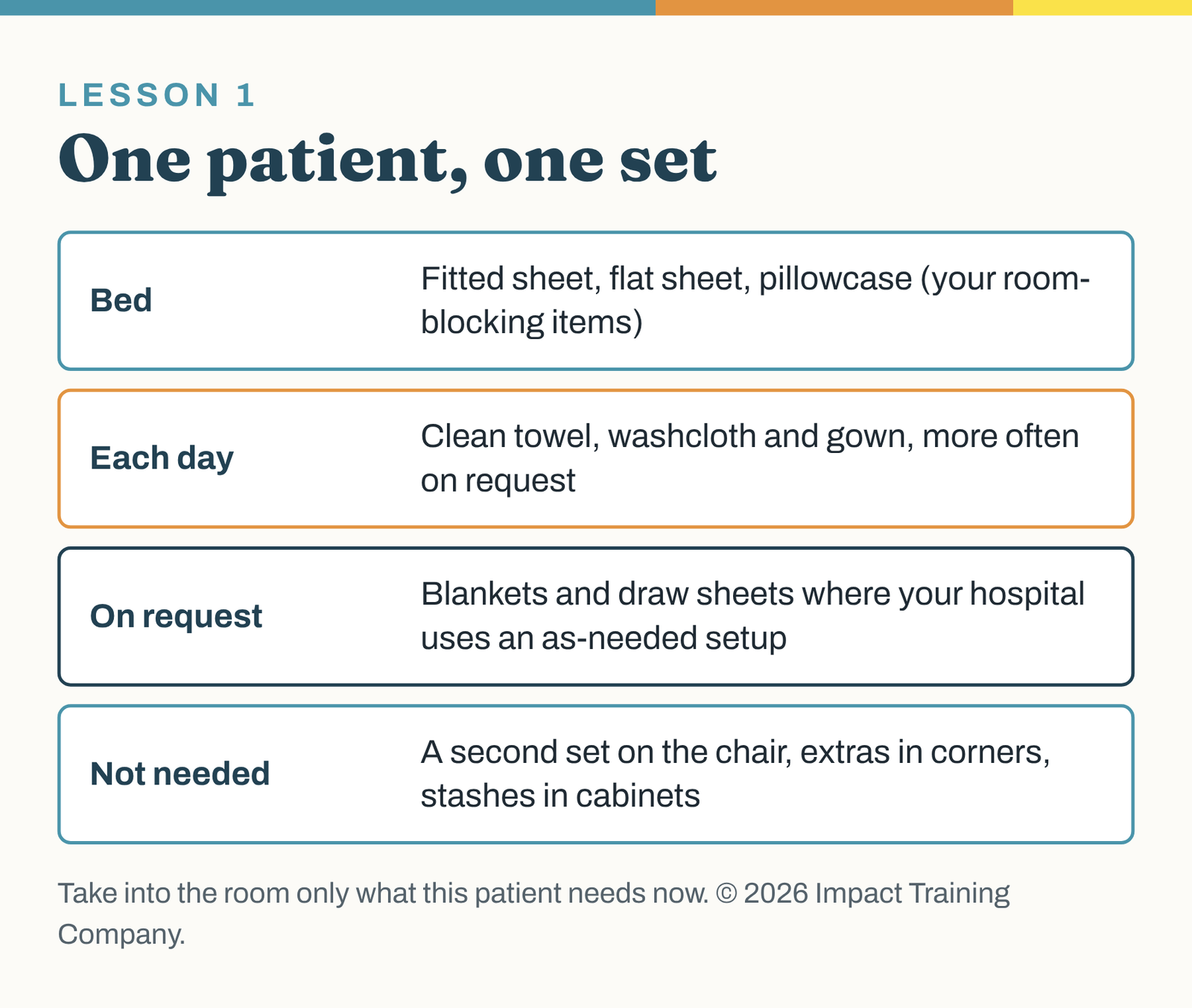
A few items carry the room. Your hospital’s bed-make standard says which ones a room cannot be released without. In most hospitals those room-blocking items are the fitted sheet, flat sheet and pillowcase, plus the gown and towels where they are part of setup. If any one is missing, the room cannot be finished. [Book]
Most hospitals place the same setup in every room for every patient: fitted sheet, flat sheet, pillow and pillowcase, gown, bath towel, washcloth, blanket and draw sheet. Many patients never use all of it. A same-day patient may not need a draw sheet. A patient who wears their own clothes does not need the gown. In many hospitals, linen taken into a room is sent to the laundry at discharge whether it was used or not. [Book]
How much is that? A health system that audited more than 100 patient rooms found an average of 3.5 pounds of clean, unused linen in every room. That figure comes from a documented implementation published by a textile manufacturer, not from peer-reviewed research. The book models what it would mean at a 280-bed hospital: roughly 56,000 to 63,000 pounds a year processed for no clinical purpose. Modeled. [Book]
The same health system changed its policy. Beds were straightened daily and sheets, pillowcases and blankets were changed as needed or whenever the patient asked. A clean towel, washcloth and gown were provided each day, or more often on request. A card on the bed stand told patients exactly that. The case study reported minimal patient complaints; the few it had came mostly from older patients who expected daily changes, which is why a clear card and a friendly offer matter. [Book]
Removing blankets and draw sheets from the standard setup and offering them on request does two things. It cuts linen use without cutting care. And a room with fewer items is faster to strip, make and turn, which means beds come open sooner. [Book]
Your hospital’s setup standard and bed-change policy are set by leaders, usually through a linen committee with nursing and infection prevention. Follow the standard your hospital has. If you see linen going to waste because of the standard, report it with an example. That is how a standard gets changed.
If your hospital uses an as-needed policy, a bed-stand card tells patients what to expect. Download the As-Needed Bed-Stand Card Template (PDF). Use it only if your hospital has adopted the policy, and edit it to match. Download the editable version (Word).

These are the everyday habits that keep linen in the loop without shortchanging anyone.
Standard infection prevention practice and CDC guidance set the clean-side habits.
OSHA’s bloodborne pathogens standard treats laundry soiled with blood or other potentially infectious materials as contaminated laundry, and most hospitals handle all soiled linen that way. [OSHA] [CDC]
Isolation rooms: CDC says linen from isolation rooms needs no special handling beyond standard precautions and minimal agitation. Wear the PPE the isolation sign calls for and follow your hospital’s bagging policy. [CDC]
Under OSHA, linen soiled with blood or other potentially infectious materials is contaminated laundry: it goes into a labeled or color-coded soiled linen bag, and in most hospitals it is laundered. It does not go in red bag biohazard waste unless your hospital’s policy names an exception. Linen in the red bag is lost for good, and the hospital pays to replace it and to dispose of it. [OSHA] [Book]
A clean, dry bed is ready except that the closet has no pillowcases. Can the room be released?
Not if pillowcases are on your hospital’s bed-make standard. A pillowcase is a room-blocking item in most hospitals. Report the shortage right away so linen can bring them.
What should you check before you put stripped linen in the bag?
Sharps and patient belongings. Look over the bed and linen for needles and for items such as glasses, hearing aids, dentures and phones, without running your hands blindly through it. Then roll it inward without shaking it and bag it in the room.
On your next shift, look at three occupied rooms. Count the linen sets and any extra items in each one: on chairs, in corners, on counters. Write down how many rooms had more than one set for one patient, and which extra item showed up most.
If you are not working in a hospital yet: think of a hotel room you have stayed in. List every linen item that was in the room and mark which ones you actually used. Write one sentence on what a hotel could change, and one sentence on why a hospital has to be more careful than a hotel about what goes back on a shelf.
Your next step: go on to the four role lessons: Nursing (Lesson 2), Nursing Assistants (Lesson 3), EVS (Lesson 4) and Transport (Lesson 5). Start with your own if you like.
Linen at the Bedside, Dock-to-Patient Linen Program, Edition 1.0 (2027 curriculum). © 2026 Impact Training Company. This course earns an ITC certificate of completion. It is not an industry credential, does not cover laundry plant processing, and does not replace your hospital’s competency validation or policies.Follow your hospital’s policy where it differs from this course.