About Course
About this course
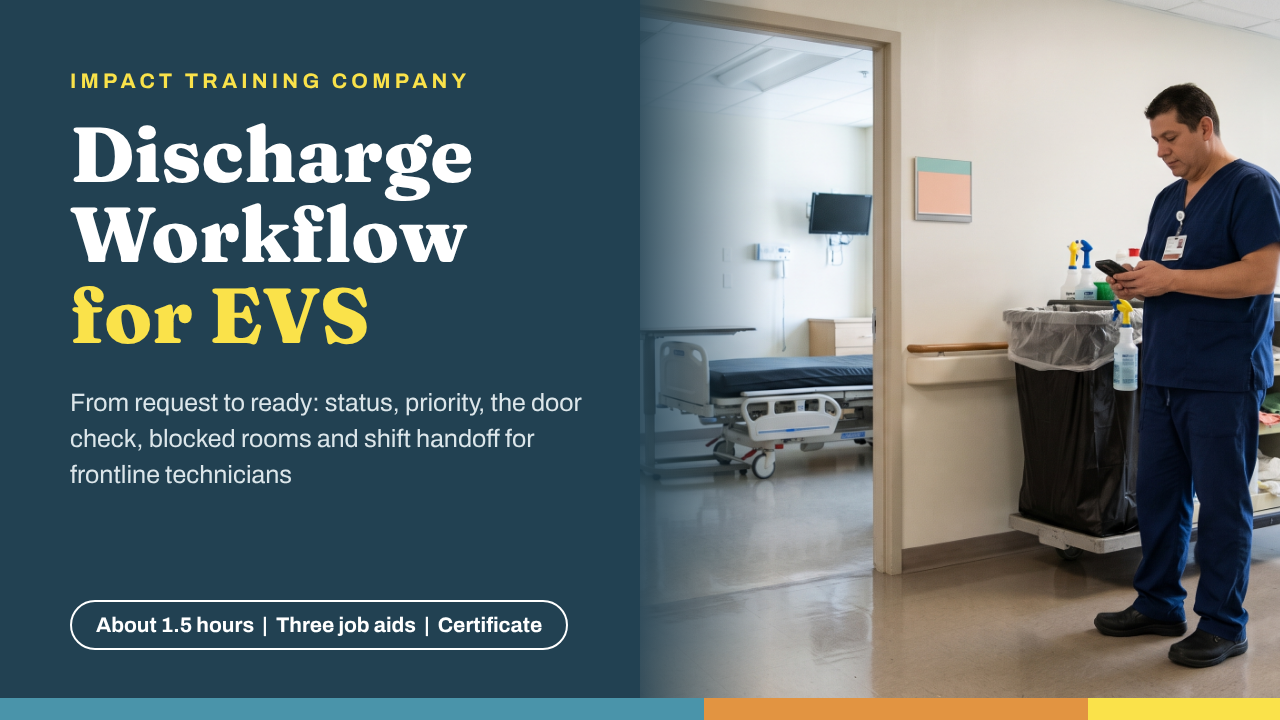
A discharge room can be cleaned perfectly and still be late. The request sat unseen, the wrong room went first, the room was not ready when you got there, or nobody knew it was finished. This course covers the work around the clean that decides the difference: requests, status, priority, the door check, blocked rooms and handoffs.
It sits next to High-Velocity Bed Turnover (the clean itself) and The 60-Second Encounter (how you talk with patients) on ITC’s EVS flow track. You do not need the other two courses to take this one.
What makes it different
- Status taught as several things at once: room condition, job assignment, delays and priority
- A three-point door check that confirms a room is released, what precautions apply, and what another team handles first
- An escalation card and a shift handoff card that keep every open room visible
- Six real-shift practice scenarios, a five-question Critical Decisions Check, and a 15-question final assessment
Your facility comes first
Hospitals use different bed tracking systems, status names and priority rules. This course teaches a common pattern with general examples. Where anything differs from your hospital’s policy or system, follow your hospital.
This course is professional development. It does not carry continuing education (CE) credit. It earns an ITC certificate of completion, which shows knowledge of the workflow taught, not hands-on skill or site authorization.
Who the EVS Discharge Workflow Course Is For
This EVS discharge workflow course is for frontline environmental services technicians who clean discharge rooms, and for the leads and dispatchers who assign that work. It covers everything around the clean that decides whether a bed is ready on time. If you already know how to turn a room, this course shows you why a perfect clean can still be late.
The welcome lesson explains how the course works. Lesson 1 breaks a discharge turn into response time, clean time and release time, and names five sources of lost response time along with the frontline actions that prevent them. Lesson 2 follows a cleaning request through your facility's workflow, whether it arrives on a device, by phone or from a nurse at your cart, and shows how to keep every status you control accurate. Lesson 3 works through priority: your facility's list sets the order, and you bring conflicts to your lead or dispatcher with the facts they need to decide.
Lesson 4 teaches the door check. Before you go in, you confirm the room is released, what precautions apply and what another team handles first. Lesson 5 covers rooms that are blocked or delayed, such as a family still packing or a pump still plugged in, and how to hand off open work at shift change without marking anything early. Lesson 6 puts it together in six real-shift scenarios where you decide what to do, what the system should show, who to tell and whether to escalate.
By the end of the EVS discharge workflow lessons, you will be able to keep every open room visible, use the escalation card and the shift handoff card, and pass the 15-question final assessment. For the full EVS flow track, see the environmental services training page.
Course Content
Start Here
Welcome and How This Course Works
Requests and Status
Priority and the Door Check
Blocked Rooms and Handoffs
Practice and Assessments
Student Ratings & Reviews