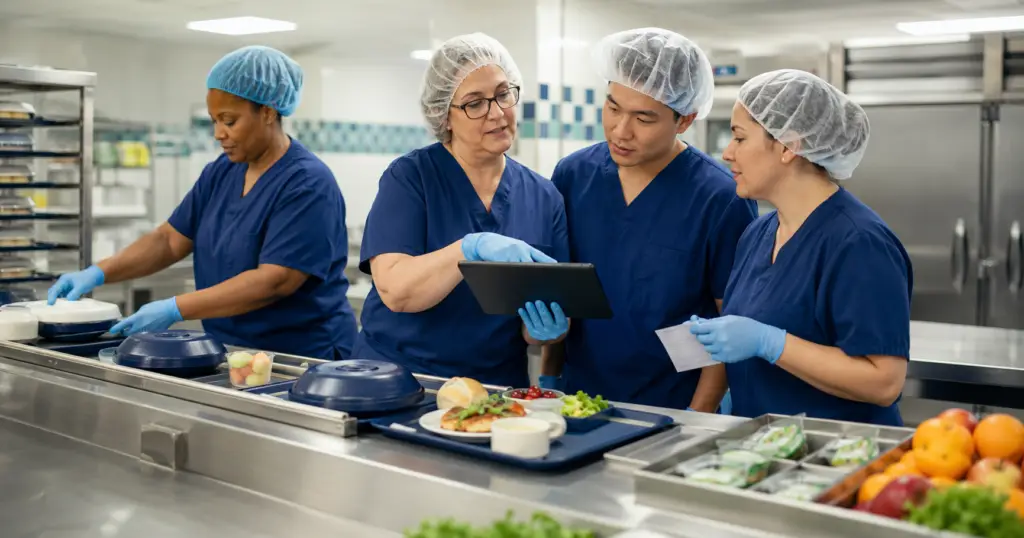
Healthcare food and nutrition services involve much more than preparing a meal and delivering a tray. The work connects food safety, diet information, meal timing, service, documentation, equipment, teamwork, and the patient’s daily experience.
Food and nutrition services are among the most visible support functions in a healthcare organization. Patients may interact with meal-service employees several times each day, and every interaction carries both an operational responsibility and an opportunity to provide professional service.
Behind each meal is a coordinated process involving receiving, storage, production, diet-order information, tray assembly, delivery, recordkeeping, sanitation, complaint handling, and communication with other departments. When employees understand how these responsibilities connect, they are better prepared to contribute consistently within the organization’s food-service system.
Healthcare food and nutrition services manage patient meals and related food-service operations, including production, tray preparation and delivery, diet-order information, food storage, service, sanitation, and the patient meal experience.
Why healthcare food service is different
Food service in a healthcare environment operates under responsibilities that may not exist in the same form in an ordinary restaurant or commercial kitchen. Patient meals must connect with approved diet information, organizational schedules, clinical activities, sanitation requirements, and healthcare-specific policies.
A meal may need to reach the correct patient at the correct location within a specific service window. The meal must reflect the information supplied through the organization’s approved ordering and diet-management system. Employees must also follow required hygiene, storage, preparation, holding, delivery, identification, and documentation procedures.
Food-service employees are not independently responsible for prescribing diets or making clinical decisions. Their responsibility is to follow the approved information and procedures provided by the organization, recognize discrepancies, and escalate questions to the appropriate person.
The frontline responsibilities behind every meal
Health and hygiene
Follow required hand-hygiene, personal-hygiene, sanitation, protective-equipment, and illness-reporting procedures.
Safe storage and handling
Receive, organize, store, prepare, hold, and transport food according to applicable requirements and employer procedures.
Meal accuracy
Follow approved diet and meal information carefully and report unclear, incomplete, or conflicting details.
Timely service
Help meals move through preparation, assembly, delivery, and retrieval according to the organization’s service process.
Patient-centered interaction
Communicate respectfully, protect privacy, explain appropriate service information, and respond professionally.
Records and communication
Complete required records accurately and communicate concerns, complaints, shortages, and service issues promptly.
Food safety begins with consistent daily behavior
Food-safety procedures are only effective when employees apply them consistently. Knowledge must become part of everyday routines—from arriving for a shift and washing hands properly to receiving supplies, storing items, preparing food, assembling trays, using equipment, and cleaning the work area.
Small lapses can introduce avoidable risk. Employees therefore need to understand not only which steps to follow, but also why those steps matter and when a concern should be reported.
- Following required hand-hygiene procedures
- Maintaining appropriate personal cleanliness
- Using required protective equipment correctly
- Preventing cross-contact and cross-contamination
- Following temperature-control procedures
- Storing food and supplies appropriately
- Inspecting items during receiving and storage
- Cleaning and sanitizing equipment and surfaces
- Reporting illness or possible contamination
- Following employer-specific food-safety policies
Employees should always follow applicable food codes, public-health requirements, employer policies, and supervisor instructions. General online education provides a foundation but does not replace site-specific training and competency validation.
How meals move through a healthcare organization
Patients experience the final meal, but food and nutrition employees manage many connected steps before the tray reaches the patient. Reliable service depends on each step being completed accurately and communicated to the next part of the process.
Receive and inspect
Deliveries are received according to organizational procedures, checked for required conditions, documented where necessary, and routed to the appropriate storage area.
Organize and store
Food, supplies, and equipment are arranged to support safety, inventory control, accessibility, cleanliness, and efficient workflow.
Prepare and produce
Employees follow approved recipes, production instructions, sanitation procedures, food-safety requirements, and assigned responsibilities.
Assemble accurately
Tray components are matched with the organization’s approved meal and diet information, with discrepancies reported before service.
Deliver professionally
Meals are moved according to required timing, identification, privacy, sanitation, and patient-service procedures.
Retrieve, record, and respond
Employees complete required retrieval, cleaning, documentation, complaint-reporting, waste-tracking, and service-recovery steps.
Food is part of the patient day
Meal timing, accuracy, communication, and service interact with procedures, nursing workflows, diet information, discharge activity, patient experience, labor, and waste. Food service is therefore both a frontline service and an operational system.
Why diet-order accuracy matters
Healthcare meals may be connected to diet orders, restrictions, allergies, texture requirements, procedures, or other approved instructions. Food and nutrition employees must use the organization’s authorized systems and processes rather than relying on assumptions or memory.
When information appears incomplete, inconsistent, or unclear, the appropriate response is not to make an independent clinical interpretation. The employee should pause the process and communicate with the designated supervisor, diet office, nursing contact, registered dietitian, or other authorized professional according to employer procedure.
Accuracy depends on multiple people and systems working together. Training helps frontline workers understand their role within that chain and recognize when information must be clarified before a meal continues through production or delivery.
Know the boundary of the role
Food and nutrition services workers should follow approved diet and meal information, but they should not independently prescribe, diagnose, reinterpret clinical instructions, or promise a patient that an unapproved change can be made. Questions should be referred through the organization’s authorized process.
Meal timing is an operational responsibility
A correct meal delivered at the wrong time can still create waste and frustration. Healthcare food service must coordinate with patient movement, procedures, tests, nursing activities, NPO instructions, unit routines, and discharge plans.
Not every delay is controlled by food and nutrition services. However, employees can contribute by following service schedules, updating meal status accurately, communicating known problems, and escalating issues before they become repeated service failures.
Move meals reliably
Follow approved production, assembly, dispatch, delivery, and retrieval schedules.
Match approved information
Use authorized meal and diet information and stop when a discrepancy requires clarification.
Keep departments informed
Communicate shortages, delays, patient-location changes, complaints, and unresolved issues.
The role of equipment in food flow
Equipment affects nearly every stage of food service. Refrigeration, storage systems, preparation tools, cooking equipment, tray lines, holding equipment, delivery carts, dishwashing systems, and temperature-monitoring tools all support different parts of the operation.
Employees need role-specific instruction before operating equipment. They should understand required inspections, cleaning, safe use, shutdown procedures, and how to report damage or improper operation.
An unavailable or poorly functioning piece of equipment can disrupt timing, increase manual work, create waste, or affect the ability to follow standard procedures. Reporting equipment issues promptly helps the organization respond before a small problem becomes a larger operational interruption.
Why food-service records matter
Documentation provides evidence that required work occurred and gives supervisors information they can use to manage the operation. Depending on the facility and assigned role, records may involve receiving, storage, temperatures, sanitation, production, waste, delivery, complaints, corrective actions, or equipment.
Records should be completed honestly, accurately, legibly, and at the time required by organizational procedure. Employees should never invent a value, copy information they did not verify, or complete a record for work they did not perform.
When a required check was missed or a result falls outside the expected range, the appropriate action is to follow the employer’s reporting and corrective-action process—not to alter the record to make it appear acceptable.
Professional service shapes the meal experience
Patients may evaluate a meal through taste, temperature, appearance, timing, accuracy, and the way the service interaction made them feel. Food and nutrition employees may not control every part of that experience, but their professionalism remains visible.
Professional service includes introducing oneself when required, confirming information through approved procedures, communicating respectfully, protecting patient privacy, listening carefully, and avoiding dismissive responses.
Employees should also understand how to respond when a patient is dissatisfied. The goal is not to argue, assign blame, or make promises outside the worker’s authority. The employee should listen, acknowledge the concern appropriately, document or report it as required, and involve the person authorized to resolve it.
A practical complaint response
- Listen without interrupting or becoming defensive
- Clarify the concern using respectful questions
- Acknowledge the patient’s experience appropriately
- Avoid assigning blame to another employee or department
- Explain only what falls within the employee’s role
- Report or escalate the complaint through the approved process
- Complete required documentation accurately
- Follow through when the employee is responsible for an action
Reducing waste without compromising requirements
Food and tray waste can result from overproduction, inaccurate information, timing problems, patient-location changes, trays sent during procedures, ordering issues, rejected meals, or ineffective inventory practices.
Frontline employees contribute to waste reduction when they follow production instructions, rotate stock correctly, maintain accurate records, communicate changes promptly, and avoid unnecessary rework. However, waste reduction should never be pursued by ignoring food-safety, diet, sanitation, or quality requirements.
Accurate waste information also helps leaders understand where the process is breaking down. If waste is hidden or recorded inconsistently, the organization loses an opportunity to identify the underlying cause.
Technical and interpersonal skills work together
Healthcare food service requires technical knowledge, but technical knowledge alone is not enough. Employees must also communicate, manage time, work across departments, respond to change, follow instructions, and interact professionally with patients and coworkers.
Technical skills
Hygiene, food handling, storage, production, equipment, tray assembly, delivery, cleaning, recordkeeping, and complaint procedures.
Professional skills
Communication, service, accountability, teamwork, time awareness, ethical conduct, problem reporting, and respect.
Impact Training Company’s workforce-development materials combine cognitive knowledge, hands-on techniques, and interpersonal skills because frontline performance depends on all three areas working together.
How training supports food and nutrition teams
Employees enter healthcare food service with different levels of education and experience. Some may understand commercial food preparation but be new to healthcare-specific requirements. Others may be entering food service for the first time.
Structured training gives learners a common foundation. It helps explain the purpose behind required procedures, introduces workplace terminology, clarifies role boundaries, and provides a consistent reference point for coaching.
For organizations, online learning can supplement orientation and help standardize foundational education across employees and shifts. Supervisors can then connect course concepts with site-specific policies, hands-on practice, observation, and competency validation.
Training is most effective when it is reinforced after course completion. Employees need access to current procedures, functioning equipment, appropriate supervision, constructive feedback, and clear reporting channels.
About the Nutrition/Food Services Worker course
Impact Training Online offers a self-paced Nutrition/Food Services Worker course designed to build practical knowledge for food and nutrition support within healthcare environments.
The current online course includes learning related to health and hygiene, proper hand hygiene, safe food storage, receiving and organization, equipment, records, complaint reporting, and other technical and professional responsibilities.
The course is delivered online, allowing learners to progress according to their schedules while organizations reinforce the material through employer-specific orientation and supervised workplace training.
Frequently asked questions
Are food and nutrition services workers clinical professionals?
Frontline food-service workers generally operate in a support-services role. They follow approved diet and meal information but should refer clinical questions or requested diet changes to an authorized professional according to employer procedure.
Is healthcare food service the same as restaurant work?
The settings share certain food-service skills, but healthcare operations add responsibilities involving approved diet information, patient privacy, clinical schedules, organizational policies, and coordination with care departments.
Can online training replace hands-on instruction?
No. Online education can provide foundational knowledge, but employees still need employer-specific orientation, supervised equipment instruction, local procedures, and required competency validation.
Why are food-service records important?
Accurate records help document required activities, identify operational issues, support supervision, and provide information for food-safety, quality, waste, and performance management.
How does food service affect patient experience?
Patients experience food service through meal accuracy, timing, temperature, presentation, responsiveness, and employee interactions. These elements help shape how the meal and overall service are perceived.
Every meal reflects a larger system
A patient meal is the visible result of many connected responsibilities. Receiving, storage, production, diet information, tray assembly, timing, delivery, sanitation, documentation, and service all contribute to the final experience.
Training helps workers understand those connections and recognize that their responsibilities extend beyond completing an isolated task. Each employee contributes to food safety, operational reliability, professional service, and the organization’s ability to deliver meals consistently.
For individuals entering the field and current workers strengthening their skills, a structured educational foundation can provide greater clarity about what the role requires and why the work matters.
Explore the Nutrition/Food Services Worker course
Develop foundational knowledge in healthcare food service through flexible, self-paced online training created for frontline support-services professionals.