
About Course
Part of When Beds Don’t Move: The Course, six Flow Physics modules of patient flow training for hospital leaders.
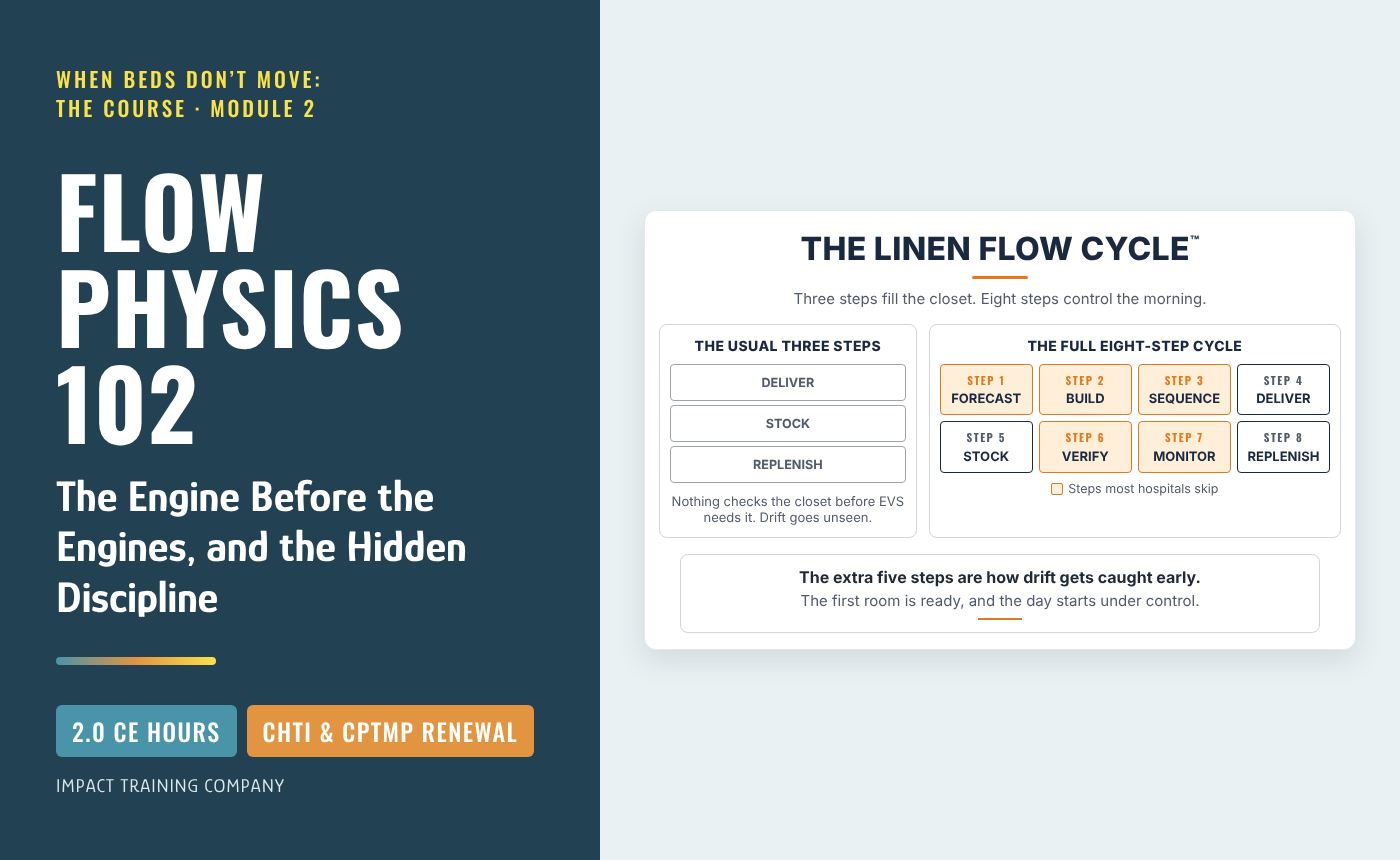
Module 2 of When Beds Don't Move: The Course. Learn why linen is the engine before the engines, how par, position, and order decide whether EVS starts its first room on time, how the eight-step Linen Flow Cycle catches drift early, and how to read Yellow signals and act before they turn Red. 2.0 CE hours. Counts toward CHTI and CPTMP renewal.
This module is built from Donald Sipp's book When Beds Don't Move, which reached #1 in Hospital Administration and Care on Amazon. The book is not required to take the course.
Course Content
The Engine Before the Engines, and the Hidden Discipline
Linen Is the First Clock
Readiness You Can Check
Where and in What Order
Every Unit Has Its Own Curve
The Linen Flow Cycle
Signals, Timing, Readiness
Act at Yellow
Practice Lab: The 7:15 Briefing
Flow Physics 102 Knowledge Check
Student Ratings & Reviews

No Review Yet