About Course
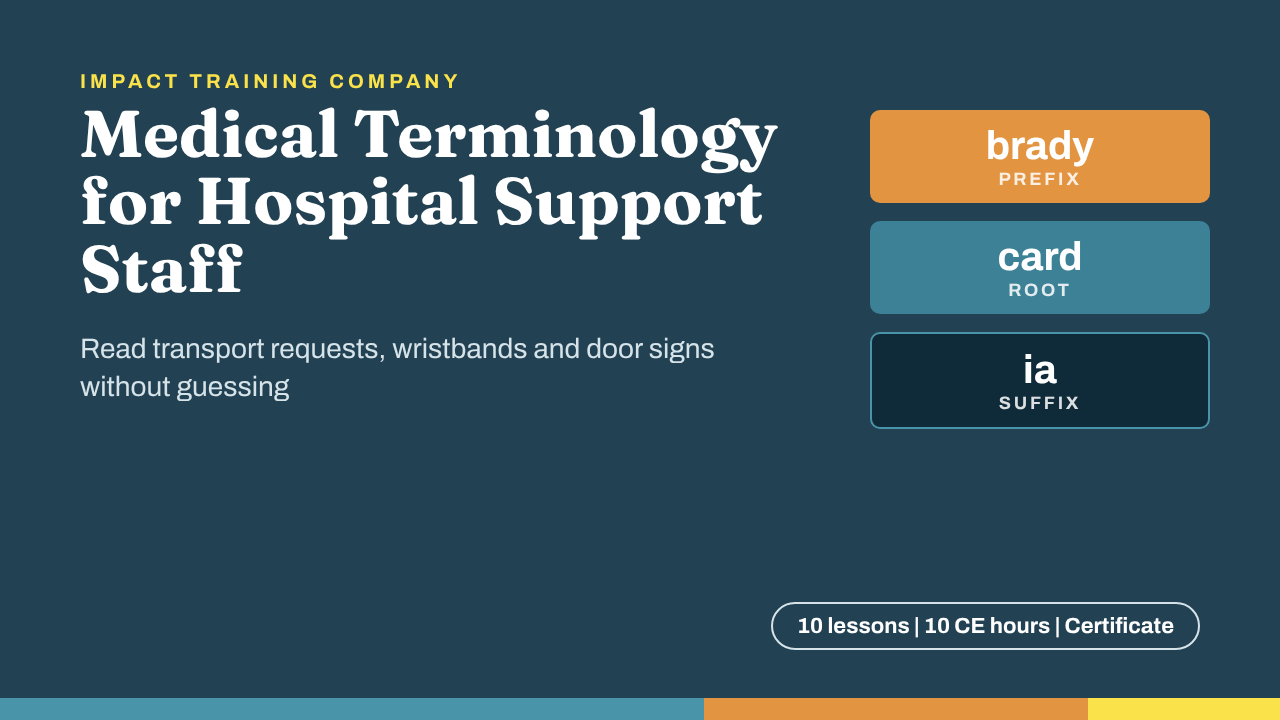
Read a transport request, a wristband or a door sign without guessing. This course teaches hospital support staff the medical language they see every shift: on dispatch screens, whiteboards, isolation signs and patient wristbands.
It is built for patient transporters, EVS and food and nutrition team members, unit clerks, and students heading into medical assistant, billing or other hospital roles. Every example comes from real support services work, not a textbook glossary.
Free download: start with the Medical Abbreviations Cheat Sheet, the 2-page job aid built from this course.
What is inside
- 10 lessons and a capstone case assignment, about 10 hours with drills and practice quizzes
- How medical words are built, so you can decode words you have never seen
- Heart, lungs, bones, brain, digestive, urinary, skin and blood terms that change how a patient moves
- Position and direction terms, abbreviations, departments, procedures and imaging
- The Five-Point Request Read for transport requests, and The Joint Commission Do Not Use list
- Four job aids: Medical Abbreviations Cheat Sheet, Word Parts Decoder, Transport Request Reading Card, and Position and Direction Terms
- A graded case assignment (six full transport requests from one shift) and a 40-question module exam, each 80 percent to pass, plus a certificate of completion
CE hours and HPT Complete
Earns 10 CE hours toward the CHT CE Active notation. This course is also Module 1 of HPT Complete, and what you pay for it is credited in full toward the program.
This certificate recognizes completion of technical knowledge training. Hands-on competency is verified by the employer. It is a certificate of completion, not a certification or license, and it does not replace your hospital's training or policies.
Course Content
Topic 1: How Medical Words Are Built
Lesson 1: How Medical Words Are Built
Lesson 1 Practice Quiz
Topic 2: Body Systems
Topic 3: Positions and Abbreviations
Topic 4: Departments and Transport Requests
Topic 5: Safe Wording
Topic 6: Practice and Module Exam
Student Ratings & Reviews