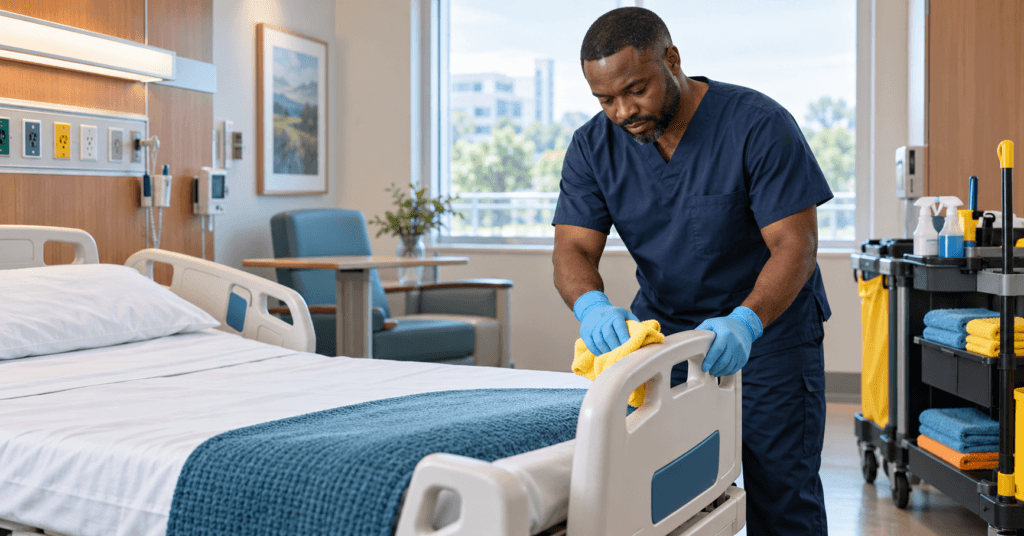
Healthcare environmental services training helps EVS teams understand the work behind a clean patient space: approved cleaning and disinfection procedures, safe product use, accurate room status, and coordination with the people waiting for a room to be ready.
When a patient leaves a hospital room, the next admission may depend on a series of separate actions. The departure must be communicated, belongings and equipment addressed by the appropriate teams, an EVS assignment made, the required cleaning completed, and room status updated accurately. A delay at any point can leave the bed unavailable even when the room itself can be cleaned efficiently.
EVS employees also perform work while rooms are occupied and across many shared spaces. Their responsibilities vary by facility and area. Training must therefore connect the general principles of environmental cleaning with the specific surfaces, products, protective equipment, precautions, and handoffs required in each setting.
Quality and readiness belong together. A fast status update cannot substitute for a completed cleaning process, and a completed cleaning process should be communicated so the next team has reliable information.
What environmental services contributes to a hospital
Environmental services, often shortened to EVS, covers the cleaning and disinfection of assigned environmental surfaces and the preparation of spaces for continued care. Patient rooms, bathrooms, corridors, waiting areas, and other spaces can each have different requirements. Responsibility for reusable patient-care equipment may be shared with clinical or other staff according to local policy, so employees need a clear division of work.
The CDC's core components for environmental cleaning and disinfection call for EVS participation in the hospital's safety culture, education for everyone who cleans patient-care areas, standardized protocols, monitoring, and feedback. The guidance is directed primarily to acute-care hospitals; other settings need to apply it in light of their own populations and requirements.
Impact Training Company describes EVS as a function connecting cleaning and disinfection with room turnaround, bed status, staffing, and quality. That operational view matters because the team has two connected tasks: perform the required work and make its progress visible to the next person in the flow.
Environmental quality
Follow the facility-approved procedure for the assigned area, including the product, surface, protective equipment, sequence, and documentation requirements.
Room readiness
Accept and prioritize assignments, communicate barriers, and report a room as ready only after the applicable process and checks are complete.
Respectful service
Work around patients, visitors, and clinical colleagues with attention to privacy, access, explanation, and the needs of an occupied care space.
Team coordination
Clarify who owns equipment, linen, belongings, access, isolation information, and final status when several departments touch the same room.
None of these responsibilities means an EVS technician should independently decide a clinical precaution or change an infection-prevention protocol. When an instruction is unclear, the right action is to pause, follow the reporting path, and obtain direction from an authorized person.
Cleaning, disinfection, and room status are different decisions
Cleaning removes soil and organic material from a surface. Disinfection uses an appropriate product and method to reduce microorganisms according to its label and the facility's procedure. Some approved products combine steps under specified conditions; workers must follow the actual instructions for the selected product and surface rather than assuming all products work alike.
Contact or wet time, dilution where applicable, material compatibility, required protective equipment, and safe storage can differ by product. A spray and immediate wipe may fail to meet the product's instructions. Supervisors should make the approved method easy to learn and perform, with access to current labels, procedures, supplies, and safety information.
“The room looks clean” is a visual observation. “The assigned cleaning and disinfection procedure is complete” is a process statement. “The room is ready for the next patient” may involve additional steps or a separate status decision. Teams need agreed meanings for those statements so an early bed-status update does not imply work that has not happened.
Routine cleaning while a patient occupies a room differs from discharge or transfer cleaning after the room is vacated. The latter may include surfaces that were inaccessible while occupied. Precautions, room type, and local infection-prevention directions may change the procedure. Staff should use the facility's current instructions for each situation.
Build EVS training around observable work
A course, handbook, or orientation session can explain why a procedure matters. Competence also requires the worker to show how they perform it in the actual setting with the tools they will use. CDC guidance calls for training upon hire, at least annually, and when new equipment or protocols are introduced, together with records of competency and retraining when monitoring finds weaknesses.
Begin with the work employees will be assigned. A trainee in patient rooms needs to recognize high-touch surfaces, the approved room sequence, product instructions, hand hygiene, protective equipment, waste and linen rules, spill escalation, and the completion signal. A worker assigned elsewhere may need additional area-specific instruction.
Explain the purpose and boundaries
Define the assigned surfaces, why the steps matter, who is responsible for nearby equipment, and which questions require infection prevention or a supervisor.
Demonstrate the approved process
Show product preparation or use, protective equipment, cleaning sequence, attention to high-touch surfaces, safe supply handling, and the local method for finishing the assignment.
Practice in the work setting
Give the learner time to perform the procedure with coaching. Use the room type and equipment they will encounter on shift.
Observe and correct
Check the actual performance against the facility's standard, explain any gap specifically, and provide another opportunity to demonstrate the required step.
Reinforce after orientation
Use periodic observation, quality findings, product or protocol changes, and worker questions to guide refreshers and coaching.
This sequence is an educational framework, not a substitute for an approved training or competency program. A local program should specify who can train and validate work, what evidence is retained, and when a person can take an assignment independently.
A useful coaching conversation
Instead of saying “Be more thorough,” a supervisor might say: “During the observed clean, the bed rail and call button were missed. Let's review the room sequence and practice those high-touch surfaces again.” The employee can then show the method, identify a supply or access barrier, and demonstrate the correction.
Training should work for the workforce using it. Plain instructions, demonstrations, translated or otherwise accessible materials where appropriate, and opportunities to ask questions help people apply the procedure. Confirm understanding by observing the task rather than relying only on a signature that a policy was read.
Map room turnaround from notification to readiness
A hospital can have a capable EVS team and still experience long discharge-to-ready intervals. Time may be lost before a cleaner is assigned, while waiting for room access, when an instruction is unclear, or after the clean while a status update waits to be entered. Those intervals need different solutions.
Impact Training Company's environmental services consulting focuses on room turnaround, discharge readiness, staffing coverage, quality, and bed-status communication. Its approach treats the operation as a connected flow rather than a race to shorten the cleaning task itself.
Map the local process with EVS, nursing, bed management, transport, infection prevention, and other participating teams. Impact Training Company's overview of hospital support services shows how EVS fits alongside transport, linen, food and nutrition, and facilities operations. The following questions help locate the handoffs without assuming every facility uses the same sequence:
- How and when is a departure or discharge communicated to EVS?
- Who confirms the room is accessible and identifies any precautions?
- How is a room assigned, and how are priorities changed?
- What must be removed or addressed by another role before cleaning?
- Which cleaning and inspection steps apply to this room type?
- Who records completion, and who changes the bed's final status?
- How are a barrier or a re-clean request sent back to the right team?
Use local data to distinguish waiting time from active work time. If a room waits for dispatch, a cleaning-speed target will not resolve the assignment gap. If an inspection repeatedly identifies a missed surface, investigate the procedure, equipment, training, supervision, and realistic time allowed.
CDC's acute-care guidance calls for facilities to establish minimum cleaning times for major room types from standardized work, align them with staffing plans, and share the expectations with people responsible for patient flow. That is a facility planning responsibility; a single universal minute target cannot describe every room, precaution, and interruption.
Improve flow without asking people to skip steps
Make the assignment visible sooner, clarify access and precautions, position supplies, establish dependable communication, and verify the work. Time gained by omitting a required step creates a false picture of readiness.
Keep room status honest and useful
Room-status terms should reflect the process that has actually occurred. A facility might distinguish “vacant,” “awaiting EVS,” “in progress,” “needs inspection,” and “ready.” The exact terms depend on its bed-management system, but staff across departments should understand the same definitions.
Do not mark a room complete to stop an alert if required work remains. Do not leave a completed room in an in-progress state when an update is due. Either error can affect assignment and bed decisions. Teach employees what to enter, when to enter it, and whom to contact if the system cannot reflect the real condition.
A delay should include a reason and next step when possible: access unavailable, required equipment pending, precaution clarification needed, product or supply issue, or another locally defined barrier. Specific information helps dispatch and leadership respond. It also prevents an individual cleaner from being blamed for an upstream wait outside their control.
Measure cleaning quality alongside turnaround
Quality monitoring should answer whether the approved procedure is being followed and where it needs support. The CDC recommends a defined strategy, which may include direct observation, fluorescent markers, or ATP methods, with decisions about who monitors, what surfaces are checked, frequency, data validation, and how feedback is shared.
No single measure tells the whole story. A visual inspection identifies visible soil or missed tasks but does not prove microbiological safety. A marker can help assess whether a selected surface was wiped but does not by itself establish correct product use or an appropriate contact time. Choose methods with infection prevention and quality leaders, interpret results within their limits, and use findings to improve the work.
Process observations
Watch whether employees can follow the approved sequence, product directions, protective-equipment rules, and high-touch-surface requirements.
Quality findings
Review inspection or monitoring patterns by room type, surface, shift, and procedure; investigate repeated gaps rather than focusing only on a single score.
Flow intervals
Separate notification-to-assignment, assignment-to-start, active clean, and completion-to-status intervals where the data allows.
Barriers and rework
Record why a clean could not begin or needed to be repeated, then identify which department or resource can address the cause.
Give findings back to the people who do the work. Feedback is more useful when employees can explain what made a step difficult and see what leadership changed in response. Use the same information to recognize reliable practice, update a confusing instruction, or arrange additional support.
Coordinate with infection prevention and clinical teams
EVS procedures sit within the hospital's wider infection-prevention program. Precaution signs, room assignments, cleaning responsibilities for shared equipment, and changes in protocol should reach the people doing the cleaning in a form they can act on.
Clinical colleagues also need to understand when EVS can begin work and what information must be provided. A room that still contains belongings, a device with unclear ownership, or a precaution not visible in the assignment may interrupt the process. Agree on the handoff rather than assuming the technician can infer the correct action.
Patient privacy and dignity remain relevant during occupied-room cleaning. Employees should use approved introductions, explain their task where appropriate, and respect directions about care activities and access. When the room cannot be entered or a surface cannot be reached, the status should show the limitation rather than imply the task was completed.
Give frontline teams the conditions to do the work
Training can teach a reliable method, but leadership must make it possible to use. Employees need the correct products, clean tools, maintained equipment, usable carts, clear assignments, and enough time for the applicable process. They also need a response when a room or product presents a condition outside routine instructions.
Coverage should reflect when work arrives, not only how many rooms are in the building. A cluster of discharges late in the day, a large number of rooms under additional precautions, or a shift change can create demand that is uneven across hours. Leaders can examine arrival patterns, assignment delays, and the mix of room types before changing a staffing plan.
Supervisors should also protect an honest reporting culture. If a worker identifies a missed step, unsafe condition, or unclear product instruction, respond to the immediate issue and then examine why it occurred. A message that rewards a quick green dashboard while discouraging reports can make the numbers less trustworthy.
Include EVS voices in workflow changes. The technician who moves between floors can often explain why a route, storage point, or status code slows the job. Test changes in the actual environment, verify quality, and adjust before treating the new process as standard.
What a practical EVS improvement review can include
Start with a bounded question: Which part of room readiness is unreliable? Observe a representative set of assignments across relevant shifts and room types. Confirm the local definitions of start, completion, re-clean, and ready. Speak with the departments that send and receive the handoff.
- Compare stated policy with how the work is actually assigned and completed.
- Review training records and observe task performance where authorized.
- Check product availability, equipment condition, and supply placement.
- Identify delays before cleaning starts and after it ends.
- Review quality monitoring and repeat-clean reasons.
- Agree on an owner, a measure, and a follow-up for each proposed change.
A department may find that coaching addresses a missed step. It may also find a broken dispatch rule, competing room-status definitions, or insufficient supply access. Diagnose the cause before prescribing another class. Any workflow change must preserve the facility's infection-prevention and worker-safety requirements.
Frequently asked questions
What does EVS do in a hospital?
EVS teams clean and disinfect assigned environmental surfaces, maintain patient-care and shared spaces, and help prepare rooms for the next patient. Exact duties, including responsibility for equipment, depend on facility policy.
Is cleaning the same as disinfection?
No. Cleaning removes soil; disinfection uses an approved process to reduce microorganisms on applicable surfaces. A combined product may have its own instructions. Employees must follow the facility's approved procedure and product label.
Can faster room turnaround and cleaning quality coexist?
Yes, when leaders improve assignment, access, supplies, communication, and status accuracy while preserving every required cleaning step. A shorter recorded interval alone does not demonstrate quality.
Does a workbook replace hands-on EVS competency assessment?
No. A workbook can support foundational learning, but the employer must teach current local protocols and verify that employees can perform assigned work with the approved products and equipment.
Is this an Impact Training Online EVS course?
No. This article discusses EVS training generally. The related Impact Training Company offerings described here are EVS workbooks and consulting. Check the online catalog separately for its current course listings.
Impact Training resources for EVS teams and leaders
Impact Training Company lists two relevant publications in its healthcare training workbook catalog: Environmental Services Technician Technical Skills Training – Participant Workbook and Strategic Skill Building for Environmental Services Technicians – Participant Workbook. These are workbooks that organizations can consider as part of workforce development, alongside their own policies, demonstrations, and competency validation.
For leaders addressing room turnaround and operational coordination, the company's EVS consulting page describes diagnostic assessments, an improvement roadmap, and implementation support. The scope includes staffing, dispatch, quality, and bed-status communication. Review the offering with the company in the context of your facility's needs.
Impact Training Online hosts a separate catalog of online courses. Do not assume that the EVS workbooks or consulting engagement are an online EVS course; consult the current listings for available online learning.
Related support-services learning can also help teams understand downstream handoffs. For example, the article on patient transport communication and handoffs discusses accurate updates as patients move between departments.
Make each room ready with confidence
A dependable EVS program does more than ask employees to clean faster. It explains the required procedure, teaches it in the setting where it is used, checks performance, fixes recurring barriers, and communicates the actual room condition to people making the next decision.
Choose one room type or handoff to examine. Trace the time from notification to assignment, observe the cleaning and quality process, and see how completion reaches bed management. The most useful improvement may be a training correction, a clearer responsibility, a supply fix, or a more accurate status update. Keep quality and worker safety in view throughout.
Strengthen your EVS operation
Explore Impact Training Company's environmental services consulting and its published training workbooks for technicians.
This article is general workforce-development information. Follow your organization's current infection-prevention policies, product labels, safety instructions, assigned roles, and competency requirements. Escalate unclear or unusual conditions through your facility's approved process.
Sources and further reading
- CDC: Considerations for Reducing Risk—Surfaces in Healthcare Facilities — acute-care environmental cleaning program components, training, room procedures, monitoring, and feedback.
- CDC: Environmental Services — environmental surface cleaning and disinfection guidance.
- Impact Training Company: Environmental Services Consulting — current consulting focus and engagement options.
- Impact Training Company: Support Services Consulting — EVS in the wider hospital support-services operation.
- Impact Training Company: Healthcare Training Books & Certifications — current EVS workbook listings.