
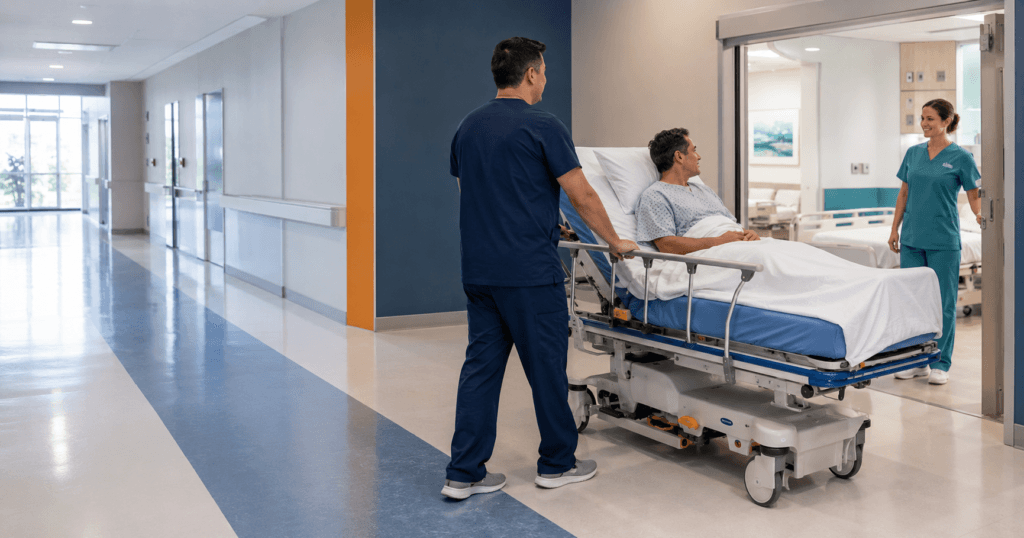
Patient transport and hospital flow are inseparable. A bed, test, procedure, transfer, or discharge may be approved, but the next operational step cannot begin until the patient actually moves.
Hospitals are networks of connected services. Nursing, environmental services, patient placement, transport, imaging, procedural areas, laboratories, case management, and other departments must coordinate information, space, people, and timing. When one part of that network becomes disconnected, a delay can travel far beyond the original request.
Patient transporters work at the physical center of this coordination. They turn a request in a system into movement through the facility. Their work must be timely, but it must also remain safe, respectful, accurately communicated, and appropriate to the patient's needs.
Patient flow is the movement of patients through the healthcare system from admission through discharge. Patient transport is the support-services function that completes many of the physical moves inside that journey.
Why patient flow is a hospital-wide responsibility
Patient flow problems often become most visible in the emergency department, but the causes may exist elsewhere. An admitted patient may wait because an inpatient bed is occupied, the discharge process is incomplete, the room has not been cleaned, placement information is unresolved, or transportation has not occurred.
The Agency for Healthcare Research and Quality describes emergency-department boarding as a hospital- or health-system-level problem requiring solutions beyond the walls of the ED. The Joint Commission's 2026 hospital performance goals similarly call for hospitals to measure components of patient flow, including bed supply, clinical throughput areas, safety, access to support services, and the efficiency of nonclinical services such as housekeeping and transportation.
This system view matters because no single department can fix a chain of delays alone. Improving one metric without understanding connected work may simply move the waiting to another part of the organization.
Transport is more than time spent moving
When leaders examine a transport delay, it is easy to focus only on the minutes during which the transporter is pushing a wheelchair, stretcher, or bed. The larger interval usually contains several stages.
The need becomes known
A test, treatment, transfer, admission, or discharge creates the need for movement. The operational clock may begin before a transport request is entered.
The request is created
The origin, destination, requested timing, priority, equipment, precautions, and other required information must be entered or communicated through the approved process.
The request is assigned
Dispatch or an automated system sequences the work according to priorities, available staff, location, equipment, and organizational rules.
The transporter reaches the origin
Travel time depends on facility size, elevator access, current location, route restrictions, and other assignments.
The patient becomes transport-ready
Identification, handoff, clinical readiness, personal belongings, equipment, precautions, and required preparation must be complete before movement.
The physical move occurs
The transporter safely moves the patient through the approved route while maintaining dignity, communication, and required precautions.
The receiving handoff is completed
The destination accepts the patient through the authorized process, and responsibility is transferred appropriately.
The status is closed accurately
The completed, delayed, canceled, or changed request is recorded so the system reflects what actually happened.
Each interval tells a different story. A long total time does not automatically prove that the transporter moved slowly. The request may have been entered late, the patient may not have been ready, the destination may have been unavailable, or the assignment may have waited in a dispatch queue.
Where transport-related delays begin
Request delay
The need for transport exists before the request reaches dispatch, reducing the available time to respond.
Incomplete information
Missing location, equipment, isolation, readiness, or timing information requires clarification and interrupts assignment.
Patient not ready
The transporter arrives but required preparation, handoff, medication, paperwork, clothing, or equipment remains incomplete.
Dispatch congestion
Requests accumulate faster than the active team can complete them, particularly during predictable demand periods.
Destination delay
The receiving area is not ready, cannot accept the patient, or has not communicated a change in availability.
Coordination failure
Departments use different assumptions about priority, timing, ownership, or what “ready” means.
The visible delay is not always the first delay
When a patient is still waiting, the transporter may become the most visible part of the process. Accurate improvement work traces the entire request from the moment movement became necessary—not only from the moment someone noticed the wait.
Why patient readiness matters
A transporter cannot safely complete a move when the required conditions are missing. Readiness may involve an approved order or request, correct patient identification, appropriate clothing or covering, required clinical preparation, available equipment, known precautions, personal belongings, and a receiving destination able to accept the patient.
Readiness is a shared operational condition, not a task owned by transport alone. Sending areas must prepare and communicate. Receiving areas must manage availability. Transport must confirm information within its role and report unresolved barriers.
Repeated “not ready” events should be measured rather than treated as ordinary noise. They consume transporter capacity, create additional trips, delay other assignments, and may cause staff to lose confidence in the dispatch system.
Speed never replaces safety
A demand for faster movement does not authorize transporters to ignore identification, precautions, equipment requirements, handoffs, or employer procedures. Reliable flow removes avoidable waiting while preserving every required safety step.
Dispatch determines what moves next
Dispatch is where individual requests become an operational queue. A strong dispatch process makes priority visible, assigns ownership, updates status, and responds when conditions change.
First-in, first-out may be appropriate for requests of equal priority, but hospital work often contains competing needs. A discharge, an ED admission, a scheduled procedure, and a routine return trip may not carry the same operational urgency. The organization must define priorities clearly enough that dispatchers and transporters do not improvise them differently from shift to shift.
Priority rules also need escalation pathways. A request can become more urgent because a procedure time is approaching, an area is waiting for capacity, or the patient's situation has changed. The system should show who can change a priority, how that change is communicated, and how the rest of the queue is protected.
Staffing must follow demand, not tradition
Transport demand changes by hour, day, service line, and season. Morning testing, procedural schedules, afternoon discharges, admissions, shift changes, meal breaks, and evening coverage can produce recurring peaks.
A department may appear adequately staffed in total while still being under-covered during the periods when requests accumulate. Conversely, adding staff without addressing late requests, patient readiness, dispatch rules, equipment location, or destination barriers may not solve the problem.
Useful staffing analysis compares demand patterns with active coverage, productive time, travel distances, assignment types, and known delays. The goal is not simply to maximize movement per employee. It is to place sufficient trained capacity where and when the hospital needs movement.
Discharge is not complete until movement occurs
A clinical discharge decision is essential, but it does not by itself make a bed available. Instructions, medication, transportation arrangements, belongings, family coordination, paperwork, patient readiness, and physical departure may still be pending.
Transport teams may support the final movement to a discharge lounge, vehicle, or approved exit point, depending on facility process. When this last movement is delayed, the occupied room cannot move into its next operational stage.
Effective discharge transport begins before the transporter arrives. Leaders should identify which steps can be completed earlier, who confirms readiness, when the request should be entered, and how changes are communicated.
Patient experience travels with the move
Patients may not understand the operational reasons behind a delay. They experience the wait, uncertainty, repeated questions, and the quality of each interaction.
Transporters contribute to patient experience through introductions, respectful communication, privacy, careful equipment use, appropriate explanations, and calm handoffs. They should not make clinical promises or provide information beyond their role, but they can help the movement feel organized and dignified.
Timeliness and courtesy work together. A fast move that feels unsafe or disrespectful is not high-quality transport. A courteous interaction does not erase an avoidable two-hour wait. Reliable service requires both operational performance and professional conduct.
Measures that reveal where flow breaks
No single metric explains transport performance. Leaders need a small connected set of measures that separates waiting, movement, readiness, demand, and completion.
Response time
Time between an accepted request or defined start point and the transporter's arrival at the origin.
Total completion time
Time from the organization's defined request point through arrival and completed handoff at the destination.
Delay reasons
Documented causes such as patient not ready, destination unavailable, equipment issue, assignment queue, or request correction.
Requests by hour
The volume and type of requested moves across the day compared with active staffing and service expectations.
On-time performance
The percentage of applicable moves completed within the organization's defined target for that request type.
Safety and service indicators
Events, complaints, incomplete handoffs, canceled trips, repeat work, and other measures that keep speed in context.
Definitions must remain consistent. If one shift starts the clock when the order is placed and another starts it when dispatch assigns the request, comparisons will be misleading. Leaders should document the start point, stop point, exclusions, priority groups, and delay categories.
How Flow Physics™ frames movement
Impact Training Company's Flow Physics™ treats hospital throughput as a connected operational system. Its concepts include First Movement Time™, Activation Windows™, a seven-engine model, the Support Services Chain™, and frontline execution.
First Movement Time™ focuses attention on the interval between work becoming available and movement actually beginning. Activation Windows™ identify recurring periods when demand rises and capacity must already be prepared. The Support Services Chain™ emphasizes that environmental services, transport, nursing, and other functions must work in rhythm rather than optimize isolated tasks.
These are proprietary Impact Training Company frameworks. Hospitals interested in formal assessment or implementation should work through Impact Training Company rather than treating a short article as the complete method.
Training turns process expectations into frontline action
A dispatch redesign or new dashboard cannot improve movement if the people doing the work do not understand the standard. Transporters need technical knowledge, role boundaries, equipment skills, communication practices, safety awareness, and clarity about how their decisions affect the larger system.
Foundational education can help new transporters learn terminology and expectations. Employer-specific orientation must then connect that knowledge with facility policies, routes, equipment, precautions, dispatch tools, emergency processes, and hands-on competency validation.
Impact Training Online's Healthcare Patient Transporter certificate provides an online entry-level technical foundation. The Certified Healthcare Transporter pathway is a deeper professional credential delivered through an instructor-led organizational process with workplace competency validation. Learn more about the distinction in our guide to the healthcare patient transporter role, skills, and career path.
What transport leaders can improve
- Map the full request-to-handoff process
- Define what patient-ready means for common move types
- Standardize priority and escalation rules
- Measure delay reasons consistently
- Compare hourly demand with active coverage
- Review equipment location and availability
- Clarify sending and receiving department responsibilities
- Coach from data and direct observation
- Protect required safety and privacy procedures
- Review cancellations, repeats, complaints, and handoff failures
Improvement should involve the departments that create, prepare, receive, and depend on transport requests. A transport department can improve its own response, but it cannot independently resolve every upstream and downstream barrier.
A practical improvement sequence
Observe the real process
Follow requests from origin to destination across different shifts and move types. Compare policy with what actually occurs.
Define the measures
Agree on timing points, priority categories, delay reasons, service targets, and quality safeguards before judging performance.
Find the repeated constraints
Separate isolated incidents from recurring readiness, dispatch, staffing, equipment, elevator, destination, or communication problems.
Redesign shared work
Assign clear ownership across sending departments, dispatch, transport, receiving areas, and leaders responsible for escalation.
Train and validate
Teach the updated process, provide supervised practice, verify competency, and make required tools and information available.
Monitor and adjust
Review performance by time, location, move type, and delay reason, then adapt coverage and workflow as demand changes.
Frequently asked questions
What is hospital patient flow?
Patient flow is the movement of patients through the healthcare system from admission through treatment, transfer, and discharge. It depends on clinical and nonclinical services working together.
How does patient transport affect hospital flow?
Transport completes many physical moves between beds, tests, procedures, units, and discharge points. When movement is delayed, the next operational step may also wait.
Is every transport delay caused by the transporter?
No. Delays can begin with late or incomplete requests, patient readiness, dispatch queues, staffing, equipment, routes, elevator access, destination availability, and cross-department communication.
Should hospitals focus only on response time?
No. Response time is useful, but leaders should also examine total completion time, delay reasons, demand by hour, on-time performance, patient readiness, safety, service, and handoff quality.
Can online training replace hands-on transport training?
No. Online learning can build foundational knowledge, but employers must provide facility-specific orientation, equipment instruction, supervised practice, current policies, and required competency validation.
Movement is where planning becomes capacity
Hospitals make thousands of decisions about admissions, tests, procedures, transfers, and discharges. Those decisions affect flow only when the connected work occurs and the patient reaches the next appropriate destination.
Patient transport is therefore not an isolated delivery function. It is an operational service that connects departments and converts readiness into movement. Its performance depends on trained frontline professionals, reliable dispatch, realistic staffing, accurate information, prepared patients, accepting destinations, and clear shared ownership.
The most useful question is not simply, “Why was transport late?” It is, “Where did movement first stop, what condition allowed that delay, and which part of the system must change to prevent it from repeating?”
Build the foundation for professional patient transport
Explore self-paced online education for individual learners or connect with Impact Training Company for organization-level transport, credentialing, and patient-flow support.